Sage 50 Isn't Outdated — It's Opinionated
Why Sage 50's local-first, data-ownership model is a deliberate choice, not a legacy artifact. How it compares to cloud-first SaaS accounting.
"You're still using Sage 50? Why don't you just move to QuickBooks Online or Xero?"
Most Sage 50 users hear this question regularly. The assumption is that Sage 50 is outdated — a legacy tool clinging to life in a cloud-first world. Move to the cloud, the argument goes, and you'll get innovation, collaboration, and modern features.
The people saying this are usually not running the business. The people actually using Sage 50 chose it deliberately, often after evaluating the cloud alternatives.
This post explains why Sage 50's model is opinionated, not outdated, and when it's the right choice.
In this guide:
- Sage 50's core model
- Data ownership and control
- Local processing and reliability
- No subscription lock-in
- Sage 50 vs. QuickBooks Online
- Sage 50 vs. Xero
- When cloud accounting makes sense
- When Sage 50 makes sense
- FAQ

Sage 50's Core Model
Sage 50 is built on three principles:
- Local-first: Your company file lives on your computer or network, not in someone else's cloud
- Data ownership: You own your data, not a vendor
- Deliberate simplicity: It does accounting, not everything
This is not accidental. It's the result of 20+ years of design decisions.
Data Ownership and Control
In Sage 50, your accounting data is a file on your computer. You control it. You back it up. You decide who can access it.
The advantages:
- No vendor lock-in: If you decide to leave Sage 50, your data goes with you. Export to CSV, import elsewhere, migrate to another system.
- No surprise changes: If Sage 50 updates the app, your data isn't affected. You control when (if ever) you upgrade.
- Privacy: Your financial data never leaves your computer. You don't have to trust a cloud provider with your confidential numbers.
- Auditability: You can see exactly how data is stored, verify it's not being shared, understand the full system.
- Flexibility: Need to customize reports? Query the database directly. Need to integrate? Connect to the local file, no API limitations.
Compare to cloud:
With QuickBooks Online or Xero, your data lives on their servers. You get benefits (access from anywhere, automatic backups, real-time collaboration). You also accept trade-offs:
- You can't own the data outright — it's licensed, not owned
- If the vendor shuts down or pivots, your data might become inaccessible
- Your financial data is subject to their terms of service and privacy policies
- Exporting data is possible but often slow and lossy (not all customizations export cleanly)
For a solo operator or a small team with sensitive data, the local-ownership model is appealing.

Local Processing and Reliability
Sage 50 runs on your computer (or your local network). It doesn't depend on internet connectivity or cloud infrastructure.
The advantages:
- No outages: If Sage 50's servers go down (they don't, it's local), you're unaffected
- No latency: Everything runs at local speeds, not over the internet
- Works offline: Need to enter a transaction without internet? No problem
- No bandwidth constraints: Large reports, complex calculations, they run at local CPU speed
Compare to cloud:
QuickBooks Online and Xero are reliable, but they're subject to:
- Occasional outages (rare, but they happen)
- Network latency (especially for large data sets or complex reports)
- Throttling if you exceed API limits
- Dependency on your internet connection (you can work offline, but sync is delayed)
For a business that needs immediate, uninterrupted access to their books (especially if internet is unreliable or slow), local processing is valuable.
No Subscription Lock-In
Sage 50 is priced per license, not per month. You buy it, you own it, you can use it indefinitely.
The advantages:
- Predictable costs: No surprise price increases (you control when you upgrade)
- No forced obsolescence: If the current version works, you can keep using it
- Lower total cost of ownership: For a small team, Sage 50's one-time cost is often cheaper than 3–5 years of cloud subscription
Compare to cloud:
QuickBooks Online and Xero are subscription-only. You pay monthly, forever. The advantages:
- Always have the latest features
- No installation headaches (updates are automatic)
- Easier multi-user access (browser-based)
The disadvantage: the cost compounds. $30/month sounds cheap; $360/year is noticeable. $3,600 over 10 years adds up.
For a stable business that doesn't need frequent updates, subscription fatigue is real.

Sage 50 vs. QuickBooks Online
| Feature | Sage 50 | QBO |
|---|---|---|
| Data location | Local/network | Cloud |
| Ownership | You own | Licensed |
| Offline access | Full | Limited |
| Cost model | One-time + optional updates | Monthly subscription |
| Multi-user | Shared network file (basic) | Full browser-based collab |
| Mobile access | No | Yes |
| API/integrations | Direct database access | REST API (rate-limited) |
| Complexity | Straightforward | More opinionated workflows |
| Learning curve | Steeper | Gentler |
| Small business fit | Excellent (if familiar) | Excellent (modern defaults) |
Who chooses Sage 50: Accountants, bookkeepers, and businesses with complex or non-standard workflows. People who want to own their data and have full control.
Who chooses QBO: Businesses that prioritize ease of use, mobile access, and real-time multi-user collaboration. People who don't want to think about accounting infrastructure.
Sage 50 vs. Xero
| Feature | Sage 50 | Xero |
|---|---|---|
| Data location | Local/network | Cloud |
| Ownership | You own | Licensed |
| Multi-user | Shared network file (basic) | Full browser-based collab |
| Reporting | Very flexible | Good but templates |
| Integrations | Direct database, purpose-built | API-based (strong ecosystem) |
| Mobile | No | Yes |
| Cost | One-time (~$400) + optional updates | Monthly ($15–50+) |
| Setup | Manual | Guided workflows |
Who chooses Sage 50: Merchants, manufacturers, complex businesses. People who need very custom reporting or deep database access for integrations.
Who chooses Xero: Growth-stage businesses, teams across multiple locations, businesses that want integration with many third-party apps. People willing to pay for ease of use.
When Cloud Accounting Makes Sense
Cloud accounting (QBO, Xero) shines when:
- You have multiple locations or team members who need simultaneous access to the books
- You want mobile access (check the books from anywhere)
- You want automatic integration with your banking, invoicing, and HR tools
- You prioritize ease over control (guided workflows, less learning curve)
- Your business model fits cloud accounting's assumptions (standard revenue recognition, simple tax structures)
If you're a growing team with collaborative needs, cloud is probably better.
When Sage 50 Makes Sense
Sage 50 is the right choice when:
- You need data ownership — your financials are sensitive, and you want them local
- You have complex or non-standard accounting — multiple cost centers, inventory classes, custom reporting
- Your team is small and stable — 1–3 people, local network, doesn't need simultaneous access
- You want reliability without internet dependency — offline functionality is important
- You're a merchant integrating with other systems — Shopify, warehouse software, etc. — and want deep integration without API limitations
- You have existing workflows and don't want to adapt to a new system's assumptions
- You want predictable costs — no subscription surprises
If your business is stable, your team is small, and you value control over collaboration, Sage 50 is a solid choice.
The Integration Angle: Why Sage 50 Works with Shopify
Here's the thing that the cloud-first crowd misses: Sage 50's local nature is exactly what makes it great for integrating with Shopify.
You can connect Shopify → Sage 50 directly. Write to the local database. No API rate limits. No "request timeout" errors. No pagination headaches. Data flows cleanly and completely.
Try the same with QuickBooks Online or Xero:
- QBO's API has rate limits (you can hit them with high order volumes)
- Xero's API has pagination (you have to request data in chunks)
- Both have complex OAuth and token refresh flows
- Both require you to manage API connectivity and retries
- Both charge per API call if you exceed free limits
A dedicated Shopify–Sage 50 integration like Sagify leverages Sage 50's local nature. Every order imports in under 2 seconds. Payouts split cleanly. Refunds reconcile perfectly. No API bottlenecks.
Could you build the same on QBO or Xero? Maybe, but you'd be fighting the platform's constraints.
The Real Choice: Opinionated, Not Outdated
Sage 50 isn't outdated. It's opinionated.
Cloud accounting chose "easy, collaborative, cloud-native." That's a valid choice. Millions of businesses run on it successfully.
Sage 50 chose "local, owned, powerful." That's also a valid choice. It's chosen by accountants, merchants, and businesses with complex needs.
The question isn't "which is better?" It's "which fits your business?"
If you're a Shopify merchant doing 200+ orders/month, with sensitive financial data, and you want a tight integration without API headaches, Sage 50 is a strong choice. Especially paired with a tool like Sagify that's purpose-built for the Sage 50 ecosystem.
If you're a growing team that needs mobile access, real-time collaboration, and a simpler workflow, cloud accounting might be better.
The mistake is assuming one is objectively better. They're different tools for different problems.
Using Sage 50 with Shopify? Book a free demo and see how Sagify leverages Sage 50's local nature to create seamless Shopify integration.
Frequently Asked Questions
Is Sage 50 going away? Should I migrate to the cloud?
Sage 50 isn't going away. It's actively maintained and updated. Migration should be a business decision, not a "the platform is dying" decision. If Sage 50 works for you, stay. If you need cloud collaboration, migrate.
Can I use Sage 50 in the cloud? (like RDP to a server)
Yes. You can rent a virtual desktop in the cloud and run Sage 50 on it. You get cloud accessibility with Sage 50's local-file model. The trade-off: you're paying for server rental and dealing with RDP latency.
Is Sage 50 more secure than cloud accounting?
Neither is inherently "more secure." Sage 50's local file is only as secure as your computer. If your machine is hacked, data is compromised. Cloud accounting is secure at the provider level (Xero, QBO spend heavily on security), but depends on the vendor's controls. For most small businesses, both are secure enough if used properly.
What if my accountant needs access to the books?
Sage 50 was designed for this: accountants access the file from their own machine, or you give them remote access. Cloud accounting makes this easier (just add a user), but Sage 50 handles it fine.
Can I integrate Sage 50 with other tools besides Shopify?
Yes. Any tool that needs to read from or write to Sage 50 can connect directly to the database or file. Integrations with payroll, inventory, HR, and CRM are common. The local database is actually a feature here.
If I migrate from Sage 50 to QBO, what happens to my data?
You can export most data from Sage 50 and import it into QBO. Historical data usually transfers cleanly. Customizations and complex GL structures might need adjustment. Work with a migration specialist if you have a complex chart of accounts.
Why isn't Sage 50 available on Mac or Linux?
Windows-only is a choice, not a technical limitation. Sage decided to optimize for Windows users. If you're on Mac, you'd need Parallels or a virtual machine to run Sage 50.
Related Reading
- Shopify Sage 50 Integration - The Complete Guide - How Sage 50's local model enables tight Shopify integration
- What a Dedicated Shopify ↔ Sage 50 Integration Actually Does - Features that leverage Sage 50's strengths
- The True Cost of Manual Shopify-to-Sage 50 Data Entry - Why automation is crucial for Sage 50 shops
- Is Sage 50 Good for a Shopify Business? - Platform fit for commerce operators
- What Is Sage 50 Shopify Integration? - Plain-language explainer on the integration boundary
Ready to get started?
Schedule a demo to see how we can help streamline your workflow.
Related articles
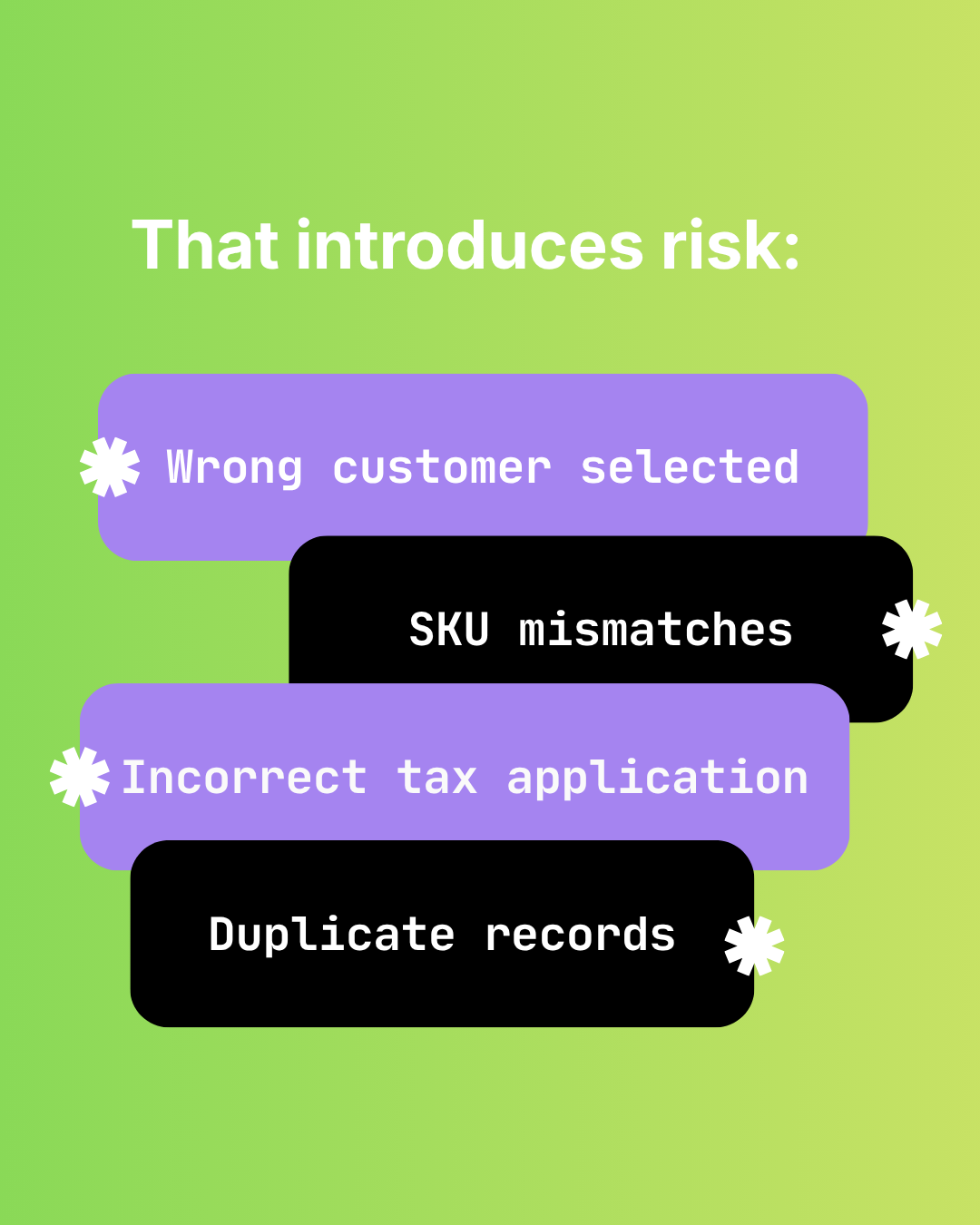
The Hidden Risks of Manual Shopify-to-Sage 50 Data Entry
Audit failure, tax errors, fraud risk, and key-person dependency. The real costs of manual Shopify to Sage 50 data entry beyond time.

How Manual Order Re-Entry Silently Corrupts Your Accounting Data
The hidden cost of manual order entry. Error rates, compounding mistakes, tax drift, and why data corruption isn't visible until month-end reconciliation.
How to Match Shopify Customers to Sage 50 Without Duplicates
Strategic customer matching between Shopify and Sage 50. Email normalization, single web-sales account vs per-customer records, B2B vs DTC flows.