The 3 Sagify Features Every Shopify + Sage 50 User Should Run
Order import, payout reconciliation, and custom GL mapping. Here's what each does and why they matter for your Shopify-Sage 50 workflow.
Sagify has one job: bridge Shopify and Sage 50. It does that job through three core features that handle the actual work of integration. Understanding what each one does is the difference between a useful tool and one that transforms your workflow.
This guide breaks down each feature, what problem it solves, and why it matters if you're running 200+ orders per month on Shopify.
In this guide:
- Feature 1: Automatic Order Import
- Feature 2: Payout Reconciliation
- Feature 3: Custom GL Mapping
- How the three work together
- What each feature saves
- FAQ

Feature 1: Automatic Order Import
What It Does
Every day, Shopify processes orders. Order Import takes those orders and turns them into sales invoices (or sales orders) in Sage 50. One by one, with all the supporting detail: customer names, addresses, line items, taxes, discounts, shipping, notes.
It's not just a summary total. Each invoice includes:
- Order metadata: Order number, date, Shopify reference
- Customer data: Name, email, billing address, shipping address. If the customer is new to Sage 50, it creates a record.
- Line items: SKU, description, quantity, unit price, line discount
- Taxes: Calculated per line item, mapped to your Sage 50 tax accounts
- Shipping: Separate line item if applicable
- Refunds: Partial or full refunds become credit notes in Sage 50
The Problem It Solves
Without automation, you're doing this manually. One order, one invoice. 20 orders per day? That's 60-100 minutes of pure data entry. 100 orders per day? That's 5-8 hours, every day, with no end in sight.
And every keystroke is a chance for error. Wrong SKU, mismatched customer, tax amount off by a cent. At scale, these errors compound into reconciliation headaches at month-end.
How It Works
- Connect Shopify via OAuth (Sagify reads your orders securely)
- Configure rules — Invoice or sales order? Customer matching logic? Account assignment?
- Select a date range — Typically "yesterday" or "last 7 days"
- Click "Process" — Sagify pulls orders and creates invoices in Sage 50
Each invoice processes in under 2 seconds. A day's worth of orders that took 2 hours now takes minutes.
What It Saves
- Time: 2-4 hours per day of manual invoice entry, depending on volume
- Errors: Near-zero keystroke errors; tax and line items match Shopify exactly
- Staffing: No need to hire extra data-entry staff for seasonal spikes
Feature 2: Payout Reconciliation
What It Does
Every few days, Shopify Payments deposits money into your bank account. That deposit is not a single transaction. It's a batch: orders minus refunds, minus transaction fees, minus chargebacks, all lumped together.
Payout Reconciliation splits that lump back into its parts and matches each part to the invoices and expenses in Sage 50. So your bank line actually reconciles cleanly.
The split includes:
- Deposit total: The amount that hit your bank account
- Gross orders: The sum of all orders in the batch
- Refunds: Subtracted, mapped to credit notes
- Transaction fees: Sage 50 expense account
- Chargebacks: If applicable, separate line item
- Discounts: Sagify fees or Shopify app fees
The Problem It Solves
Without this, you're left with: "Shopify deposited $14,237 on Tuesday. I have 157 orders that day totaling $15,103. Where's the $866 difference?"
You open a spreadsheet, manually subtract refunds, look up the fee structure, try to back into the numbers. It takes 30-60 minutes. You might still be off by a few cents.
For stores doing multiple deposits per week, this becomes a significant recurring task. And it's error-prone: one miscalculated refund or fee and your bank rec is out again.
How It Works
- Orders are imported (Feature 1 handles this)
- Shopify deposit lands in your bank account
- Click "Reconcile Payouts" in Sagify
- Sagify queries your Shopify payout history and matches it to invoices in Sage 50
- Creates a bank deposit record in Sage 50 with line items for orders, refunds, fees
The result: your bank line and Sage 50 agree without manual adjustment.
What It Saves
- Time: 30-60 minutes per week of manual payout reconciliation
- Accuracy: Zero variance between Shopify deposits and Sage 50 bank records
- Audit trail: Clear connection between orders, refunds, and bank deposits

Feature 3: Custom GL Mapping
What It Does
Not every business has the same chart of accounts. You might have separate revenue accounts per product line, per sales channel, or per geography. You might have custom accounts for wholesale vs. DTC. You might map taxes to specific accounts based on jurisdiction.
Custom GL Mapping lets you tell Sagify how to route each order to the right GL accounts. Instead of dumping everything into "Sales Revenue," Sagify can split orders by rules you define.
Examples of mapping rules:
- By product line: Orders for "Hats - Wool" go to Revenue 4000-W; orders for "Hats - Cotton" go to 4000-C
- By sales channel: Shopify orders go to 4100-Online; wholesale orders still go to 4100-Wholesale
- By geography: Canadian orders go to 4050-CAD; US orders go to 4050-USD
- By tax jurisdiction: Sales tax goes to 2100-Sales Tax Payable; GST goes to 2105-GST Payable
- By customer: Enterprise customers might have revenue tracked separately from retail
The Problem It Solves
Without this, you're forced to either:
Use generic accounts — Everything goes to "Shopify Sales." Your GL structure flattens. You lose the detail you built Sage 50 to track.
Do manual adjustments — Sagify imports everything to a default account; you spend an hour per week reclassifying invoices to the correct GL codes. You've just moved the manual work, not eliminated it.
Use a tool that doesn't support it — Some integrations force you to migrate to a simpler chart of accounts. You lose years of accounting structure.
How It Works
- Define your mapping rules during setup
- Sagify asks: "Which orders should go to which accounts?" and "What if this order has multiple attributes?"
- You configure rules — "If the product line is X and the shipping address is in state Y, route to account Z"
- Orders are imported and automatically routed to the right GL accounts
No manual reclassification. No post-import cleanup. The invoices land in the right place from day one.
What It Saves
- Time: 30-90 minutes per week of GL reclassification (if you were doing it)
- Accuracy: Orders hit the right accounts automatically, no human intervention
- Reporting: Your GL structure stays intact; you get meaningful reports immediately
How the Three Work Together
Feature 1 brings orders in. Feature 3 puts them in the right place. Feature 2 closes the bank loop.
Together, they eliminate the entire manual Shopify-Sage 50 bridge.
A Day in the Life
Morning:
- Sagify runs at 8 AM. It pulls yesterday's Shopify orders and creates invoices in Sage 50.
- Each invoice goes to the right GL account based on your mapping rules.
- You spot-check a few invoices to make sure everything looks right. Takes 5 minutes.
Friday:
- Shopify Payments deposits land in your bank account.
- You click "Reconcile Payouts" in Sagify.
- Sagify matches deposits to invoices, creates a bank deposit record with all line items.
- Your bank reconciliation is done. No variance.
Month-end:
- Your GL is already current (orders flow in daily).
- Inventory is already updated (synced with each order).
- Bank is already reconciled (Payout Reconciliation handled it).
- Close happens on day one, not day five.

What Each Feature Saves
| Feature | Problem | Time Saved | Errors Reduced |
|---|---|---|---|
| Order Import | Manual invoice entry | 2-4 hrs/day | Eliminates keystroke errors |
| Payout Reconciliation | Manual bank rec | 4-8 hrs/month | Eliminates variance hunting |
| Custom GL Mapping | Post-import reclassification | 2-4 hrs/week | Eliminates routing errors |
For a store processing 200+ orders per month, the aggregate is 15-25 hours per month of manual work eliminated.
Ready to see these features on your data? Book a free demo and we'll walk through how each feature works with your specific Sage 50 setup.
Frequently Asked Questions
Do I have to use all three features?
No. You can use any combination. Most merchants use Order Import from day one. Payout Reconciliation and GL Mapping are optional but highly recommended for accuracy and efficiency.
Can I customize the mapping rules?
Yes. Custom GL Mapping is built for flexibility. We can set up rules for product line, channel, geography, tax jurisdiction, customer type, or any combination.
What if my Sage 50 chart of accounts changes?
You can update your mapping rules at any time. Changes apply to future imports. Historical invoices are unaffected.
How long does it take to set up Custom GL Mapping?
Depends on complexity. Simple setups (2-3 rules) take 15-30 minutes. Complex multi-jurisdiction or multi-product-line setups might take 1-2 hours, usually with our support team's help.
What if an order doesn't match any of my mapping rules?
You define a "default" rule for unmapped orders. Typically, these go to a catch-all account, which you can review and reclassify manually if needed (rare).
Can Payout Reconciliation handle multiple payment gateways?
Yes. Sagify can match multiple Shopify Payments deposits, PayPal deposits, Stripe deposits, or other gateways. Each gets routed to the appropriate bank account in Sage 50.
Related Reading
- A 7-Step Walkthrough of How Sagify Actually Works - Step-by-step product tour
- Custom GL Mapping: Making an Integration Work Within Your Sage 50 Setup - Deep dive on GL mapping
- Shopify Sage 50 Integration - The Complete Guide - Full integration overview
- How to Automatically Import Shopify Orders into Sage 50 - Order import details
- How to Reconcile Shopify Payouts in Sage 50 - Payout reconciliation details
- How to Sync Sage 50 and Shopify Inventory - Inventory sync feature details
- What Is Sage 50 Shopify Integration? - Plain-language intro before the features
Ready to get started?
Schedule a demo to see how we can help streamline your workflow.
Related articles

Sagify Isn't for Everyone — Here's Who It IS For
The honest fit assessment. Good fit, bad fit, and everything in between. Know whether Sagify solves connecting Shopify with Sage 50 before you download.
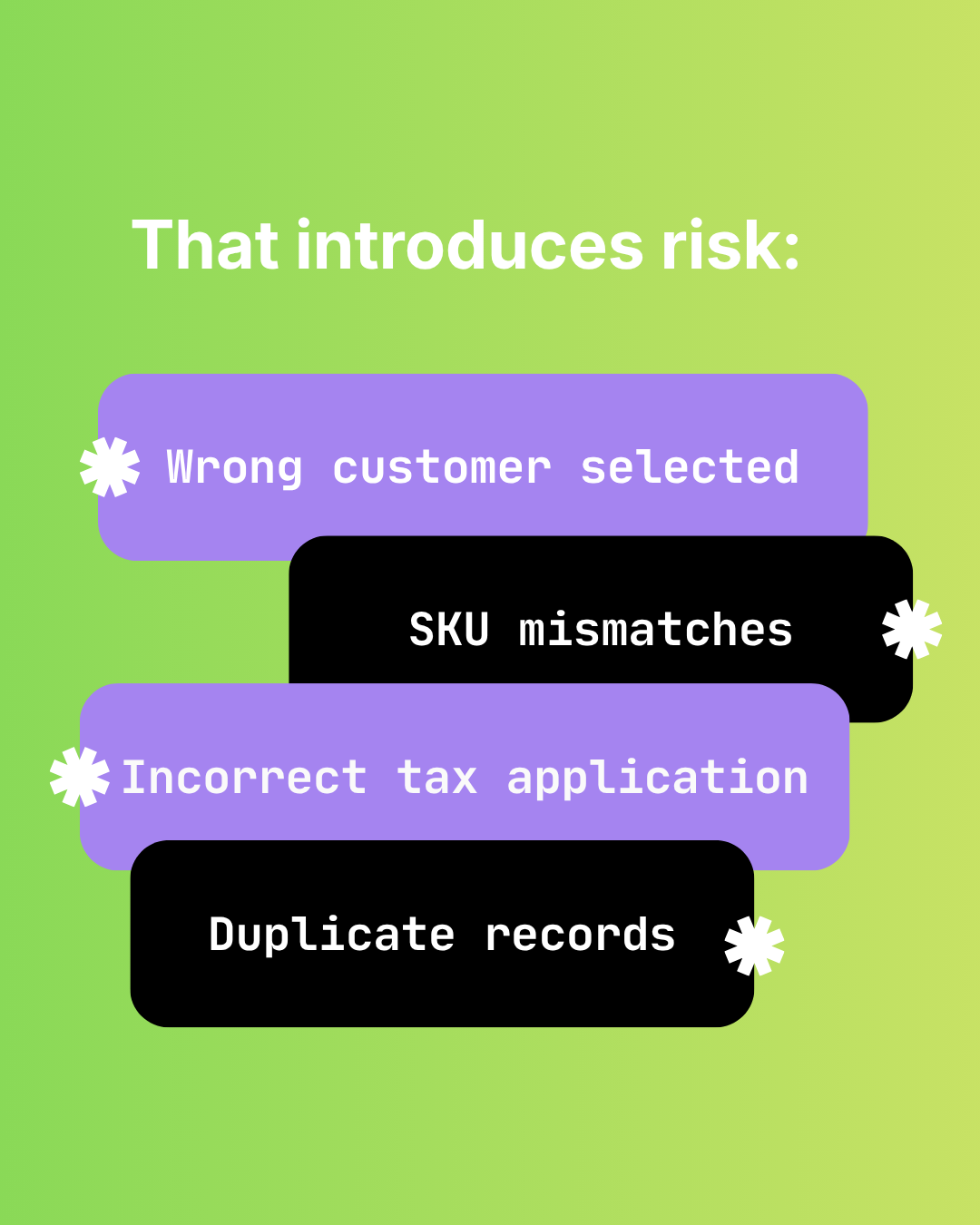
The Hidden Risks of Manual Shopify-to-Sage 50 Data Entry
Audit failure, tax errors, fraud risk, and key-person dependency. The real costs of manual Shopify to Sage 50 data entry beyond time.

How Manual Order Re-Entry Silently Corrupts Your Accounting Data
The hidden cost of manual order entry. Error rates, compounding mistakes, tax drift, and why data corruption isn't visible until month-end reconciliation.