Shopify to Sage 50 in the UK: Why the Connectors Differ
Sage 50 Accounts (UK and Ireland) is a different program from Sage 50 US and Canada, with its own SDK, tax model and connectors. What a UK connector has to do, who makes one, and why Sagify doesn't.
A Shopify connector built for Sage 50 in the United States or Canada will not work with Sage 50 Accounts in the UK and Ireland, and the other way round. The three products share a name and nothing else: different code, different data, different programming interfaces, different tax. That's why the connectors for them are different products from different companies, and why Sagify, our connector for the US and Canadian editions, doesn't support Sage 50 Accounts. This post explains the differences, what a UK connector actually has to do, who makes one, and what to look for if you're choosing.
At a glance:
- Sage 50 Accounts (UK and Ireland) descends from Sage Sterling and Sage Line 50. Sage 50 US descends from Peachtree. Sage 50 Canadian Edition descends from Simply Accounting.
- A UK connector writes through Sage Data Objects (SDO), available only to members of Sage's UK developer programme, and must run on a Windows machine that can reach the Sage data.
- There is no REST API for Sage 50 Accounts, and the older SData web interface was withdrawn in 2025.
- UK connectors include Hyperext's HyperShop, Zynk Workflow, Tradebox One, Red IT's ShopifyExchange, DataLink and Commercient. Sagify, CartSpan and Storehub are US or Canadian only.
- A UK business that wants a connector with nothing to install can use Sage Accounting, Sage's browser product, instead.
In this post:
- Three products called Sage 50
- How a program gets into Sage 50 Accounts
- What a UK Shopify connector has to handle
- Who makes a Shopify connector for Sage 50 Accounts
- Why Sagify is US and Canada only
- If you'd rather not install anything
- FAQ
Three Products Called Sage 50
| Sage 50 Accounts | Sage 50 US Edition | Sage 50 Canadian Edition | |
|---|---|---|---|
| Sold in | UK and Ireland | United States | Canada |
| Lineage | Sage Sterling (1989), Sage Line 50, Sage 50, briefly Sage 50cloud, back to Sage 50 in 2023 | Peachtree (1978), bought by Sage in 1998, renamed Sage 50 in 2013 | Bedford Accounting (1985), Simply Accounting, renamed Sage 50 in 2013 |
| Editions | Standard, Professional | Pro, Premium, Quantum | Pro, Premium, Quantum |
| Current release | v34.1 (autumn 2026), after v33 and v33.1 earlier in the year; Sage is moving to two major releases a year | 2026.x, phased out from November 2025 | 2026.x, from November 2025, with a 2027 SDK already published |
| Tax model | VAT with T-codes, Making Tax Digital for VAT and, from 2026, for Income Tax | US sales tax by jurisdiction | GST, HST, PST and QST by province |
| Programming interface | Sage Data Objects (SDO), ActiveX DLLs, UK developer programme members only | Sage 50 .NET SDK, 32-bit, with an application ID issued by Sage | Sage 50 CA SDK, through Sage's partner hub |
| Sagify | Not supported | Sagify US | Sagify Canada |
Sage itself lists at least seven unrelated products sold under the "Sage 50" name worldwide once you add France, Germany, Spain and South Africa. The number was chosen in the UK to mean "up to 50 employees", and the brand was later applied to the acquired North American products.
How a Program Gets into Sage 50 Accounts
Sage 50 Accounts keeps your books in a data folder (ACCDATA) on a PC or a server on your network. There is no cloud service in front of it, so a Shopify connector has to run on a Windows machine that can open that data, through the interface Sage provides for the purpose:
- Sage Data Objects (SDO) is a set of ActiveX DLLs that give a program an object-based view of the company data: customers, suppliers, nominal codes, invoices, sales orders, stock, the audit trail. It can read, create, edit and delete. Sage supports it from C# and Visual Basic .NET.
- Only members of Sage's UK Developer Programme get the developer tools and the SDO installers for each release. Sage doesn't publish the fee; one vendor states it starts above £3,000 a year. Every connector you'll meet is built by a member, and a new Sage release can need a new SDO build before a connector supports it.
- Third-party integration is switched on by default in current versions. Older versions (up to v24.0) needed an SDO serial number and activation key under Tools → Activation → Enable Third Party Integration.
- There is no REST API for Sage 50 Accounts. Sage says so plainly. The older SData HTTP interface stopped being maintained on 30 September 2025 and is officially unsupported from v33, so a connector that relied on it has had to move to SDO.
- The bundled ODBC driver is read-only. Good for reports, useless for posting orders.
- Remote Data Access data isn't reachable through SDO, so a connector runs where the data is: on the server, on the PC that holds it, or on a hosted desktop (Azure, AWS or a Sage hosting partner) alongside Sage. Some vendors install a Windows service on that machine; some run a workflow engine on it; some use a standalone SDO install on a separate box that can reach the data over the network.
Compare that with Sage 50 US, where the connector loads Sage's .NET SDK from the Sage 50 install folder, must be compiled 32-bit, carries an application ID issued by Sage, and is authorised by the user inside Sage 50 the first time it connects. The two interfaces have nothing in common beyond "runs on Windows next to the data", which is why a US connector can't be recompiled for the UK.
What a UK Shopify Connector Has to Handle
Beyond the mechanics, the books themselves are different. Check these on your own data, not in a demo:
- Your version. v33, v33.1 and v34.1 all shipped in 2026, and the cadence is going to twice a year. Ask which versions are supported today and how quickly a new one is.
- Where it runs, and whether that matches your setup: a server, a single PC, a hosted desktop. Some connectors aren't supported in hosted environments at all.
- VAT. The VAT Shopify charged has to land on the right T-code per line: standard, reduced, zero-rated, exempt, EU and overseas sales, and tax-inclusive prices. Your VAT return comes from these codes, so a connector that puts everything on T1 is wrong for anyone selling abroad or selling zero-rated goods.
- Sales orders or invoices. Sales order processing is a Sage 50 Accounts Professional feature. On Standard, orders go straight to invoices. If a connector promises sales orders, check your edition.
- Customers. Named sales ledger accounts for trade customers, a single web-sales account for the public, and matching that doesn't create duplicates on a retry.
- Stock. Quantities from Sage to Shopify, matched on product code, and what happens to a Shopify SKU that isn't a Sage product.
- Refunds as credit notes against the original invoice. Several UK vendors don't mention refunds at all on their pages; ask.
- Shopify Payments payouts as sales receipts, with the fees posted, so the bank feed line matches. This is usually the top tier of a vendor's pricing.
- Despatch back to Shopify, with tracking, when the order is allocated or despatched in Sage.
- Making Tax Digital. Nothing in a connector files for you, but everything it posts ends up in the return, so the VAT codes above are an MTD question too.
Who Makes a Shopify Connector for Sage 50 Accounts
As of November 2026, from the vendors' own published material:
| Connector | Runs | What it publishes | Published price (ex VAT) |
|---|---|---|---|
| Hyperext HyperShop | Windows background service on the server that holds the Sage data; Sage 50 Accounts Professional v28 onwards | Orders to sales orders in near real time, stock to Shopify, despatch and tracking notifications, trade customers to their sales ledger account (Advanced tier), payouts as sales receipts with fees (Pro tier). Refunds not mentioned. | £95, £150 or £240 a month plus £600 to £1,200 setup, by order volume, on an annual subscription |
| Zynk Workflow | On your own infrastructure, through SDO; supports Sage 50 UK and also the US and Canadian editions; tested with v30 to v34 | Orders, customers, payouts and balance transactions out of Shopify; products, stock, prices, fulfilments and refunds back | Quoted: annual subscription plus a one-off implementation fee, 1 to 4 weeks |
| Tradebox One | Not stated on its site; listed on the Sage UK Marketplace for Sage 50 | Customers, invoices or sales orders and bank receipts in Sage, stock across channels, individual invoices per order for VAT detail; also eBay, Amazon, WooCommerce and others | £82.50 to £220 a month, or £750 to £2,000 a year, by number of channels |
| Red IT ShopifyExchange | Windows PC or server; Sage 50 or Sage 200 UK and Ireland | Customers, products, orders, payments and refunds into Sage; stock levels back | From £1,500 a year |
| DataLink (Holbi) | Not stated | Orders, stock, two-way products, customers | From £395 (the page doesn't say whether one-off or recurring) |
| Commercient SYNC | A cloud platform (AWS); how it reaches the Sage 50 desktop data isn't published | Orders to sales orders, stock and prices to Shopify, fulfilment status, customers | From $199 a month per connected source, with the sync itself quoted |
Not on this list, because they don't support Sage 50 Accounts: Sagify (US and Canada), CartSpan (US only), Storehub (Canadian edition), eBridge/Jitterbit (its marketplace listing names Sage 50 US 2013 to 2018, and its Sage 50 UK connector needs an installed agent). A2X and Combidesk on the Sage UK Marketplace connect to Sage Accounting, not Sage 50, and A2X lists Sage 50cloud as unsupported.
Sage itself doesn't make a Shopify connector for Sage 50 Accounts, and its guidance on the subject is to contact the marketplace vendor. AutoEntry, which Sage owns, captures documents into Sage 50 and has no Shopify link.
Why Sagify Is US and Canada Only
Sagify is built on the Sage 50 US .NET SDK and the Sage 50 Canadian SDK, with the US and Canadian tax models (state and local sales tax; GST, HST, PST and QST) and the US and Canadian document types. Supporting Sage 50 Accounts would mean a third program on a third interface with a VAT engine, under a separate developer programme, and tested against two Sage releases a year. We'd rather do two editions properly than three badly, so if you're on Sage 50 Accounts, the table above is where to look. If you're on Sage 50 US or Canada, start here.
If You'd Rather Not Install Anything
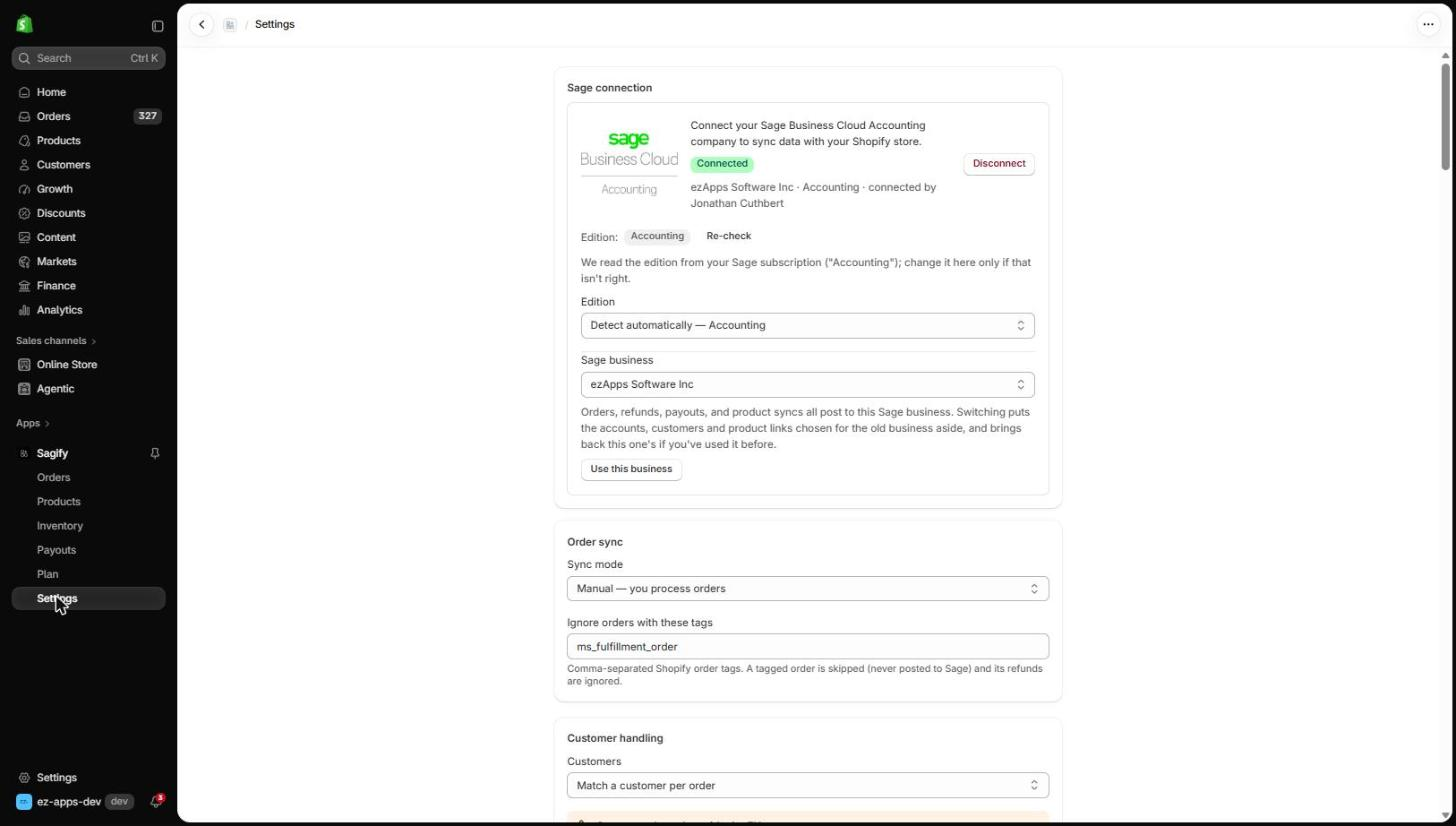
The reason a Sage 50 Accounts connector is a Windows program is that Sage 50 Accounts is one. Sage's browser-based product, Sage Accounting (the former Sage One and Sage Business Cloud Accounting), has a cloud API, so its Shopify connector can live inside Shopify admin with nothing installed and no machine that has to stay on. Sagify for Sage Accounting does that for UK and Irish businesses: orders to invoices with the right VAT rates, refunds to credit notes, payouts reconciled, stock matched, and a free plan to start.
That isn't a reason to leave Sage 50 Accounts if it's doing its job. It is the answer for a new business choosing between the two, and for a store whose Sage 50 is used for little more than sales and VAT. Our post on whether Sage Accounting suits a small Shopify store covers where it fits and where it doesn't.
Frequently Asked Questions
Does Sage 50 Accounts integrate with Shopify?
Not on its own. Sage doesn't make a Shopify connector for Sage 50 Accounts. Third-party connectors from Hyperext, Zynk, Tradebox, Red IT, DataLink and Commercient do it, running on a Windows machine that can reach your Sage data and writing through Sage Data Objects.
Can I use Sagify with Sage 50 Accounts in the UK?
No. Sagify is built for Sage 50 US Edition and Sage 50 Canadian Edition. For Sage 50 Accounts, see the vendors in this post. For Sage Accounting in the UK or Ireland, Sagify for Sage Accounting installs from the Shopify App Store.
Does Sage 50 Accounts have an API?
Not a web API. Programs integrate through Sage Data Objects, a Windows component available to members of Sage's UK developer programme. The SData HTTP interface was withdrawn in 2025, and the bundled ODBC driver is read-only.
Does a UK connector work with Sage 50cloud Accounts?
Yes, in the sense that Sage 50cloud Accounts is the same desktop program with cloud extras; Sage has since dropped the "cloud" from the name. The one caveat is Remote Data Access: data shared that way isn't reachable through SDO, so the connector has to run on the machine that holds the data.
Do I need Sage 50 Accounts Professional for a Shopify connector?
Only if you want Shopify orders to become sales orders, because sales order processing is a Professional feature. On Standard, orders become invoices. Some connectors require Professional outright; check before you buy.
Is Sage 50 Accounts the same program as Sage 50 in the US?
No. Sage 50 Accounts descends from Sage Line 50, developed in the UK. Sage 50 US descends from Peachtree, developed in Georgia. They have different data structures, different tax handling and different programming interfaces, so their connectors are different products.
Related Reading
- Does Sage 50 Integrate with Shopify? - The same question for the US and Canadian editions
- Hyperext vs Sagify, and the Other Sage 50 Shopify Connectors - A side-by-side of the connectors named here
- Sage One, Sage Business Cloud or Sage Accounting: Which Do I Have? - Telling the browser product from Sage 50
- Sage and Shopify integrations - Which Sagify fits which Sage
Read next
- Shopify Sage 50 integrationSagify posts Shopify orders, inventory, refunds and payouts into Sage 50 — US and Canadian editions.
- Sage + Shopify integrationsWhich Sagify fits your Sage: Sage 50 US, Sage 50 Canada or Sage Accounting.
- Sage 50 integration buyer's guideAn honest comparison of the Shopify to Sage 50 desktop connectors.
Related articles

Does Sage 50 Integrate with Shopify?
Not on its own. Why Sage 50 has no built-in Shopify connection, which Sage 50 you have, the four ways to connect them, and what a connector must do.

Hyperext vs Sagify, and the Other Sage 50 Shopify Connectors
Hyperext's HyperShop connects Shopify to Sage 50 Accounts in the UK; Sagify connects it to Sage 50 US and Canada. A fair comparison of both, plus Zynk, Tradebox, CartSpan, Storehub, Commercient and the rest, by edition.
Sage One, Sage Business Cloud or Sage Accounting: Which Do I Have?
Sage One, Sage Business Cloud Accounting and Sage Accounting are three names for one browser-based product. How to tell it from Sage 50 and Sage 50cloud in a minute, and why it decides how you connect Shopify.