Your Top Questions About Sagify, Answered
Comprehensive FAQ about Sagify pricing, setup, supported Sage 50 versions, security, and onboarding for the Shopify-Sage 50 integration.
We've spent hundreds of hours talking to Shopify merchants who use Sage 50. The same questions come up repeatedly. What does Sagify cost? How long does setup take? Do you handle my version of Sage 50? Can I run it on multiple stores? What happens to my data?
This post consolidates the answers. If your question isn't here, contact our support team and we'll answer it directly.
In this post:
- Pricing and licensing
- Supported versions and editions
- Trial and onboarding
- Multi-store and multi-currency
- Data security and privacy
- Setup and implementation
- Running and scaling
- FAQ

Pricing and Licensing
How much does Sagify cost?
Sagify pricing varies by Sage 50 edition (US or Canada) and volume tier. Current pricing is listed on the Sagify product page. We don't list specific dollar amounts here because pricing changes with new features, and volume breaks — the product page always has the current rates.
Is there a free trial?
Yes. Every Sagify license includes a free trial period. You get full access to all features, process real orders into your actual Sage 50 company file, and see the results firsthand before committing to a subscription.
Do you offer annual or multi-year contracts?
Sagify is available as a monthly subscription with no long-term contract. You can cancel anytime. Contact sales if you need a quote for a multi-year commitment or enterprise license.
Is there a setup fee or onboarding cost?
Standard onboarding is included with your Sagify license. If you want white-glove setup where our team configures everything for you, reach out to support for details on that service.
Supported Versions and Editions
Which versions of Sage 50 does Sagify support?
Sagify follows the current versions Sage 50 US and Sage 50 Canada. Due to limitations imposed by Sage, you must always update your Sage to the latest version to continue using Sagify. Version computability includes Premium, Quantum, Accountant editions. If you're unsure, contact support and we'll confirm compatibility with your specific version.
What's the difference between Sage 50 US and Sage 50 Canada?
Sage 50 US is the United States edition with US chart of accounts, tax rules, and reporting. Sage 50 Canada is the Canadian edition with Canadian provinces, GST/PST/HST, and Canada-specific rules. Sagify has separate editions to match. Sagify US handles Sage 50 US accounts. Sagify Canada handles Sage 50 Canada accounts.

Trial and Onboarding
How long is the free trial?
Standard trial length is 7 days. You get 7 days of full access to test with your real data.
Can I extend the trial?
Contact support if you need an extension. We sometimes grant additional time if you're in the middle of a busy season or working through a complex setup.
What happens to my data after the trial ends?
Your data stays in your Sage 50 company file, where it's always been. If you don't purchase a license, Sagify simply stops running. You can re-activate at any time.
How long does setup take?
Most setups are complete in 30 minutes to 1 hour:
- Download and install: 5 minutes
- Connect Shopify (OAuth): 5 minutes
- Link Sage 50 company file: 2 minutes
- Map accounts: 15 minutes
- Test run: 5 minutes
It is possible to complete the setup yourself; however, we offer white-glove service to complete the setup alongside you--free of charge!
Do I need to be an accounting expert to set up Sagify?
No. Setup is designed for the person who uses Sage 50 daily — your bookkeeper or controller. At most, you will need someone to know which accounts to map to. For example, Order Discounts go into our 4250 GL account. You're mapping accounts and selecting how invoices are created, not writing code or managing servers. If you get stuck, support is available.
Multi-Store and Multi-Currency
Can I use Sagify with multiple Shopify stores?
Yes, you can have multiple Shopify stores with specific setups per store in Sagify. You can push those orders to any number of Sage 50 company files. Most merchants with multiple stores either consolidate into one Sage 50 company (with account segregation per store) or maintain separate Sage 50 files per store.
For details on multi-store accounting strategy, see our multi-store guide.
What if I want to consolidate multiple stores into one Sage 50 company file?
Sagify can post orders from multiple stores into a single Sage 50 company. You configure separate revenue accounts per store (or use tags/cost centers to segregate). Each import run can be filtered by store.
Does Sagify handle multi-currency orders?
Yes. If you sell in multiple currencies (USD, CAD, EUR, etc.), Shopify converts everything to your Shopify base currency before settling. Sagify captures both the transaction currency and the settled amount, and posts to Sage 50 with the correct conversion rate. If you Shopify store is based in USD, then all your orders get converted to that currency, and Sagify uses the converted amount to create matching invoice. This allows you to reconcile easier when Shopify pays you out.
Data Security and Privacy
Where is my data stored?
Sagify is a Windows desktop application that runs on your computer. It connects directly to your Shopify store (via API) and your local Sage 50 company file. No business data — orders, customers, inventory — is stored on Sagify's servers or any external server. The only data Sagify retains is anonymous telemetry (usage patterns, error logs) to help us improve the product.
Does Sagify see customer data (addresses, emails, phone numbers)?
Yes, Sagify reads customer data from Shopify orders so it can create customer records in Sage 50. However, Sagify does not store this data anywhere other than Sage 50. It's processed in memory and posted directly to your local company file. Shopify employs encrypted data transfer when communicating via API, so any intercepted traffic could never be deciphered.
Is my Sage 50 data encrypted?
Sage 50 uses its own security and encryption for the company file. Sagify interacts with the company file through Sage 50's local APIs. We do not add, bypass, or weaken any Sage 50 security.
Who has access to my Sage 50 company file when Sagify is running?
Only the user who runs Sagify has access. You must have Sage 50 opened and logged into as user. Sagify mounts to that user to establish the connection.
Setup and Implementation
What do I need to set up Sagify?
You need:
- A Windows PC (Sagify is a desktop application, requires Windows 10 or later)
- A Shopify store (any plan level)
- A Sage 50 company file (latest version, US or Canada edition). You can have your company file stored on a shared network.
- Shopify admin access (or at least the ability to install apps on your store)
- Sage 50 admin access (or a user with 3rd party app privileges)
Can I run Sagify on a Mac or Linux?
No, Sagify is Windows only. Certain Mac + Linux can enable Windows booted environments. Please note Sagify has not been tested in this manner.
Can I run Sagify on a shared network drive?
While possible, it is best to install Sagify wherever the Sage 50 Desktop application is installed. Your company file can be hosted on a shared network.
What if I have multiple team members?
Yes, you can have multiple team members with a shared login.
How often should I run Sagify?
That's up to you. Many businesses run it daily. Some run it weekly. You choose. The workflow is:
- Open Sagify
- Select a date range or select specific orders
- Click "Process"
- Have a sip of coffee or tea
Can I run Sagify automatically on a schedule?
Sagify is a semi-automatic app. We call it a Human-in-the-loop process whereby someone is in charge of telling the app when to import orders. Most bookkeepers, controllers, data entry specialists like to feel in control and see what is going into their Sage 50 books, and being able to review it as well.
Full automation is available. Please reach out to our support team for a quote.
Running and Scaling
What happens if I get a surge in orders (Black Friday, sale event)?
That's awesome! Your plan dictates how many orders you can process in a month. If the order surge falls within your monthly allowance, then you are fine. If you go past your monthly limit, then you are charged per additional order. See your specific plan for more details.
How many orders can Sagify handle in a single import?
Sagify has been tested with 1000+ orders in a single batch without performance degradation. Most imports process at <5 seconds per invoice.
What if something goes wrong during an import?
Sagify has comprehensive error handling. If a specific order fails (e.g., missing SKU, malformed customer data), Sagify logs the error and continues with the next order. You can review the failure report and fix it (usually by adding the missing product to Sage 50) before re-running that order.
Can I undo an import?
Sagify imports create standard Sage 50 documents (invoices, credit notes). You can delete them in Sage 50 the same way you'd delete any document. However, duplicate prevention means if you re-run the import, you won't accidentally recreate them. Unfortunately, or fortunately, the Sage 50 API limits our ability to undo transactions. You will need to manually handle this. Backing up is your friend!
What if I make a mistake configuring the import rules?
You can change the configuration anytime. New rules apply to the next import run. Previous imports are left as-is (they're standard Sage 50 documents). It is good practice to backup your company file before larger imports!
Frequently Asked Questions
Do you offer training or documentation?
Yes. Every Sagify license includes access to setup guides, video walkthroughs, and our support team. For customers who prefer guided training, white-glove onboarding is available.
What kind of support do you offer?
Email support is included with every license. We typically respond within 24 hours on business days. For urgent issues, contact support to discuss premium support options.
Can Sagify import historical orders (before I started using Sagify)?
Yes. You can set Sagify to import orders from any date range, including historical orders. Duplicate prevention ensures you won't create duplicates if some of those orders are already in Sage 50.
Does Sagify integrate with Shopify POS and Sage 50?
Yes. If you use Shopify POS alongside your online store, both channels feed into Shopify and Sagify imports all transactions. For details on managing in-store and online orders, see our POS integration guide.
What about other payment gateways (PayPal, Afterpay)?
Shopify handles the payment gateway integration. Sagify imports whatever Shopify shows, including orders paid via PayPal, Klarna, Afterpay, and other gateways connected through Shopify. You can configure specific behaviors in Sagify to handle these gateways. For example, all PayPal orders are assigned to a PayPal customer or specific GL account in Sage 50.
Can Sagify handle refunds and returns?
Yes. Refunds are imported as credit notes in Sage 50, linked to the original invoice. Partial refunds, full refunds, and return orders all work correctly.
Ready to Get Started?
For current pricing, editions available in your region, and to start your free trial, visit Sagify.
For questions not answered here, contact our support team.
Related Reading
- How to Import Shopify Orders into Sage 50 - Decision tree for import methods
- Shopify Sage 50 Integration with Sagify - Complete integration overview
- Shopify Multi-Store Accounting in Sage 50 - Running multiple stores with one Sage 50 file
- POS + Shopify + Sage 50: Multi-Channel Orders - Handling both online and in-store sales
- How to Reconcile Shopify Payouts in Sage 50 - Payout automation
- What Is Sage 50 Shopify Integration? - Explainer for first-time buyers
- 5 Signs You Need a Sage 50 Shopify Integration - When Sagify is the right move
Ready to get started?
Schedule a demo to see how we can help streamline your workflow.
Related articles
Inventory Problems Start Upstream — Not in the Warehouse
Bad data, not bad counting. Why orders don't sync, refunds don't decrement, adjustments don't propagate. Data hygiene before physical reconciliation.
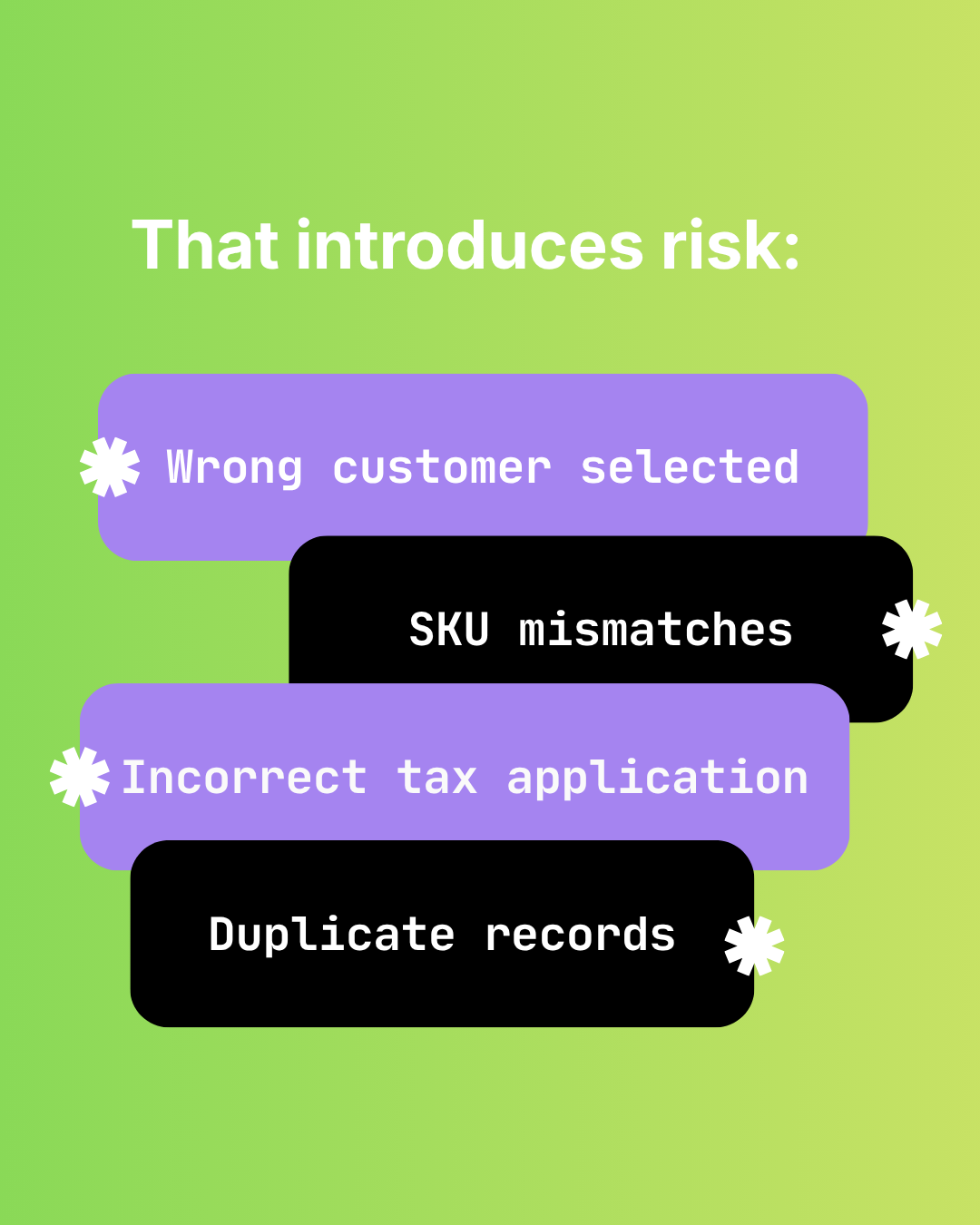
The Hidden Risks of Manual Shopify-to-Sage 50 Data Entry
Audit failure, tax errors, fraud risk, and key-person dependency. The real costs of manual Shopify to Sage 50 data entry beyond time.

How Manual Order Re-Entry Silently Corrupts Your Accounting Data
The hidden cost of manual order entry. Error rates, compounding mistakes, tax drift, and why data corruption isn't visible until month-end reconciliation.